 Add to Chrome
 Add to Firefox
 Add to Edge
Leveraging Transformer Decoder for Automotive Radar Object Detection
Jan 19, 2026
In this paper, we present a Transformer-based architecture for 3D radar object detection that uses a novel Transformer Decoder as the prediction head to directly regress 3D bounding boxes and class scores from radar feature representations. To bridge multi-scale radar features and the decoder, we propose Pyramid Token Fusion (PTF), a lightweight module that converts a feature pyramid into a unified, scale-aware token sequence. By formulating detection as a set prediction problem with learnable object queries and positional encodings, our design models long-range spatial-temporal correlations and cross-feature interactions. This approach eliminates dense proposal generation and heuristic post-processing such as extensive non-maximum suppression (NMS) tuning. We evaluate the proposed framework on the RADDet, where it achieves significant improvements over state-of-the-art radar-only baselines.

Synthetic FMCW Radar Range Azimuth Maps Augmentation with Generative Diffusion Model
Jan 09, 2026The scarcity and low diversity of well-annotated automotive radar datasets often limit the performance of deep-learning-based environmental perception. To overcome these challenges, we propose a conditional generative framework for synthesizing realistic Frequency-Modulated Continuous-Wave radar Range-Azimuth Maps. Our approach leverages a generative diffusion model to generate radar data for multiple object categories, including pedestrians, cars, and cyclists. Specifically, conditioning is achieved via Confidence Maps, where each channel represents a semantic class and encodes Gaussian-distributed annotations at target locations. To address radar-specific characteristics, we incorporate Geometry Aware Conditioning and Temporal Consistency Regularization into the generative process. Experiments on the ROD2021 dataset demonstrate that signal reconstruction quality improves by \SI{3.6}{dB} in Peak Signal-to-Noise Ratio over baseline methods, while training with a combination of real and synthetic datasets improves overall mean Average Precision by 4.15% compared with conventional image-processing-based augmentation. These results indicate that our generative framework not only produces physically plausible and diverse radar spectrum but also substantially improves model generalization in downstream tasks.
High-Resolution Range-Doppler Imaging from One-Bit PMCW Radar via Generative Adversarial Networks
Mar 17, 2025

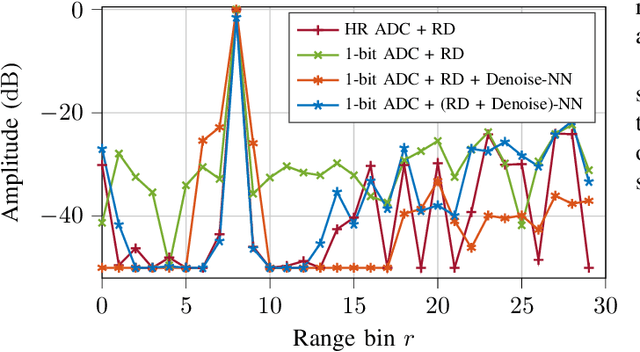

Digital modulation schemes such as PMCW have recently attracted increasing attention as possible replacements for FMCW modulation in future automotive radar systems. A significant obstacle to their widespread adoption is the expensive and power-consuming ADC required at gigahertz frequencies. To mitigate these challenges, employing low-resolution ADC, such as one-bit, has been suggested. Nonetheless, using one-bit sampling results in the loss of essential information. This study explores two RD imaging methods in PMCW radar systems utilizing NN. The first method merges standard RD signal processing with a GAN, whereas the second method uses an E2E strategy in which traditional signal processing is substituted with an NN-based RD module. The findings indicate that these methods can substantially improve the probability of detecting targets in the range-Doppler domain.
Direction Finding for Software Defined Radios with Switched Uniform Circular Arrays
Feb 12, 2025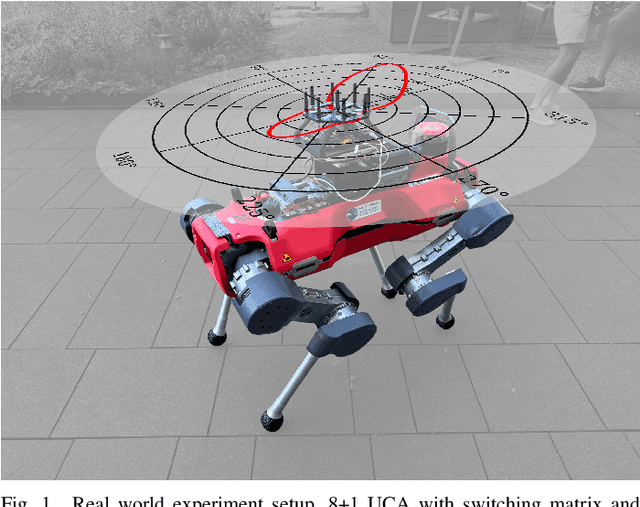


Accurate Direction of Arrival (DoA) estimation is critical for applications in robotics and communication, but high costs and complexity of coherent multi-channel receivers hinder accessibility. This work proposes a cost-effective DoA estimation system for continuous wave (CW) signals in the 2.4 GHz ISM band. A two-channel software-defined radio (SDR) with time-division multiplexing (TDM) enables pseudo-coherent sampling of an eight-element uniform circular array (UCA) with low hardware complexity. A central reference antenna mitigates phase jitter and sampling errors. The system applies an enhanced MUSIC algorithm with spatial smoothing to handle light multipath interference in indoor and outdoor environments. Experiments in an anechoic chamber validate accuracy under ideal conditions, while real-world tests confirm robust performance in multipath-prone scenarios. With 5 Hz DoA updates and post-processing to enhance tracking, the system provides an accessible and reliable solution for DoA estimation in real-world environments.
In-Situ Calibration of Antenna Arrays for Positioning With 5G Networks
Mar 08, 2023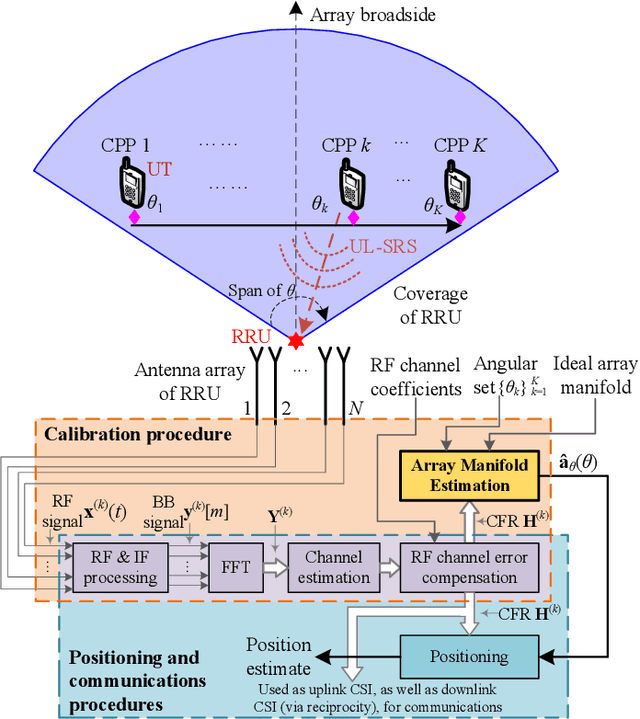
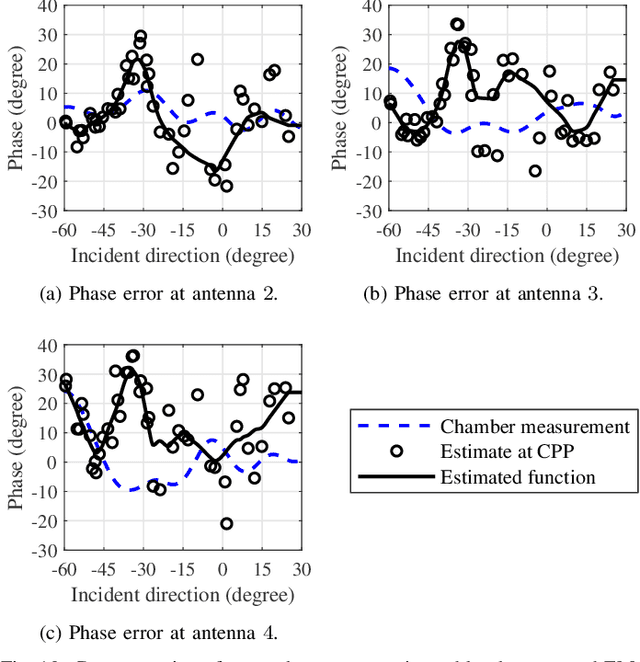
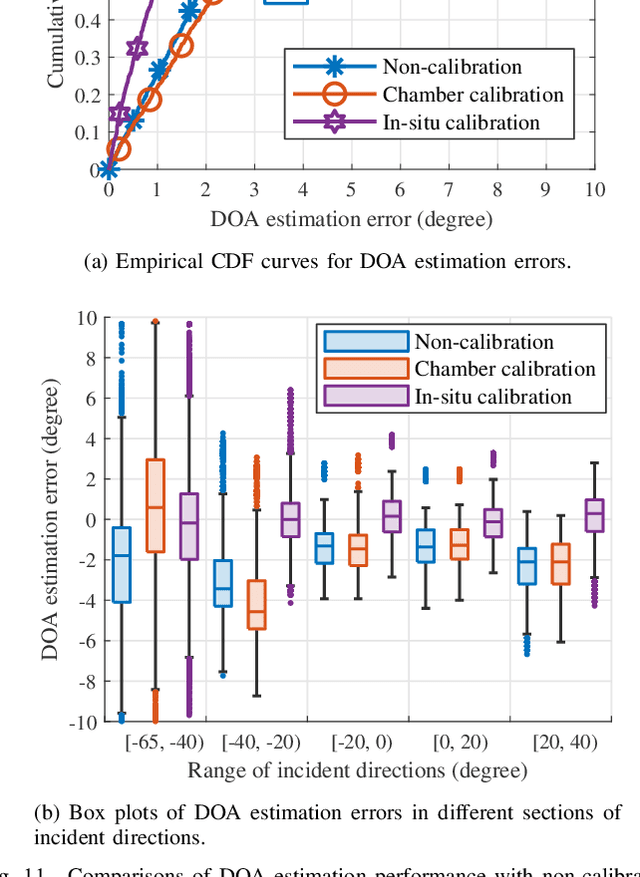
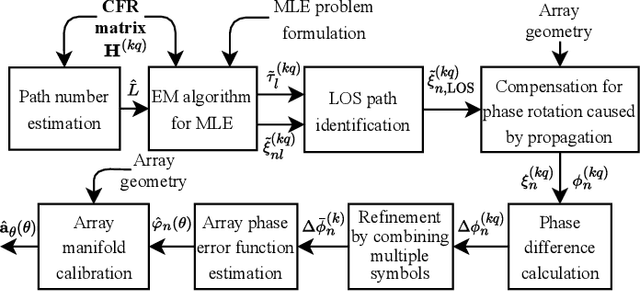
Owing to the ubiquity of cellular communication signals, positioning with the fifth generation (5G) signal has emerged as a promising solution in global navigation satellite system-denied areas. Unfortunately, although the widely employed antenna arrays in 5G remote radio units (RRUs) facilitate the measurement of the direction of arrival (DOA), DOA-based positioning performance is severely degraded by array errors. This paper proposes an in-situ calibration framework with a user terminal transmitting 5G reference signals at several known positions in the actual operating environment and the accessible RRUs estimating their array errors from these reference signals. Further, since sub-6GHz small-cell RRUs deployed for indoor coverage generally have small-aperture antenna arrays, while 5G signals have plentiful bandwidth resources, this work segregates the multipath components via super-resolution delay estimation based on the maximum likelihood criteria. This differs significantly from existing in-situ calibration works which resolve multipaths in the spatial domain. The superiority of the proposed method is first verified by numerical simulations. We then demonstrate via field test with commercial 5G equipment that, a reduction of 46.7% for 1-${\sigma}$ DOA estimation error can be achieved by in-situ calibration using the proposed method.
A Radar Kit for Hands-On Distance-Learning
Jan 20, 2023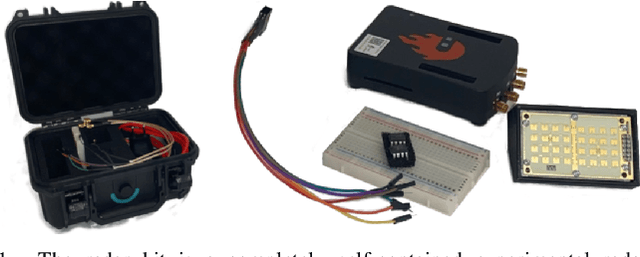
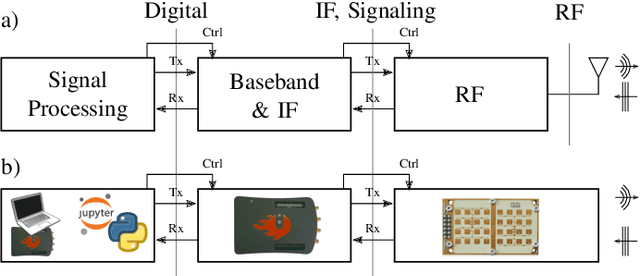

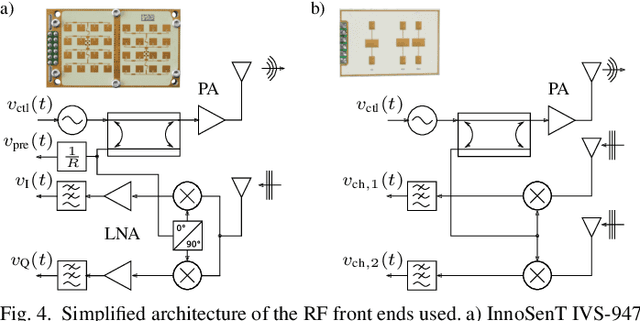
We present an approach to experimental radar systems education based on a combination of commercial low-cost hardware with modern open-source software technologies. Following a discussion of the general top-level architecture of flexible, software-defined radar systems, we introduce the specific selection of subsystems, their capabilities, and current system limitations. Compared to existing approaches to practical radar education, a more top-level modular design with a greater focus on performance and flexibility of baseband processing is selected while reducing the complexity of circuit and subsystem assembly and total system cost. We present example measurements obtained from the radar kit. The radar kit allows for bringing a radar lab to the students instead of students into the labs. It enables practical hands-on radar education also in distance-only-learning scenarios.